China Top EV Charger Installation Mistakes to Avoid

Time:2026-10-12 Author:Ethan
0%

China’s EV market is expanding quickly, but charger installation is not a task for guesswork. A wall box may look simple, yet its safety depends on cable routing, circuit capacity, grounding, and site conditions. What are common mistakes in EV charger installation? Many problems begin before the charger is unpacked.

Installers sometimes choose equipment by charging speed alone. That choice can overload an older distribution board or create unnecessary expense. A proper assessment checks parking distance, cable length, breaker rating, residual-current protection, ventilation, and weather exposure. It also confirms whether the building can support the planned load. A neat cable route matters too. Loose wiring, sharp bends, or an unsealed outdoor entry point can cause heat, moisture damage, or repeated faults.

Real projects often reveal uncomfortable details. A garage may share one circuit with a freezer, lights, or workshop tools. A metal conduit may stop just short of the dampest wall. Even experienced teams can miss a warning sign when schedules become tight. That is worth remembering. Qualified electricians should test voltage, insulation, grounding, and protective devices after installation. Manufacturer instructions and inspection records should remain available for the owner.

This guide examines China’s top EV charger installation mistakes to avoid, from weak site surveys to poor commissioning. It focuses on practical decisions, not perfect-looking photos. Some recommendations may require adjustment for the vehicle, property, and charger model. Careful planning costs less than repairing damaged equipment or losing charging access.
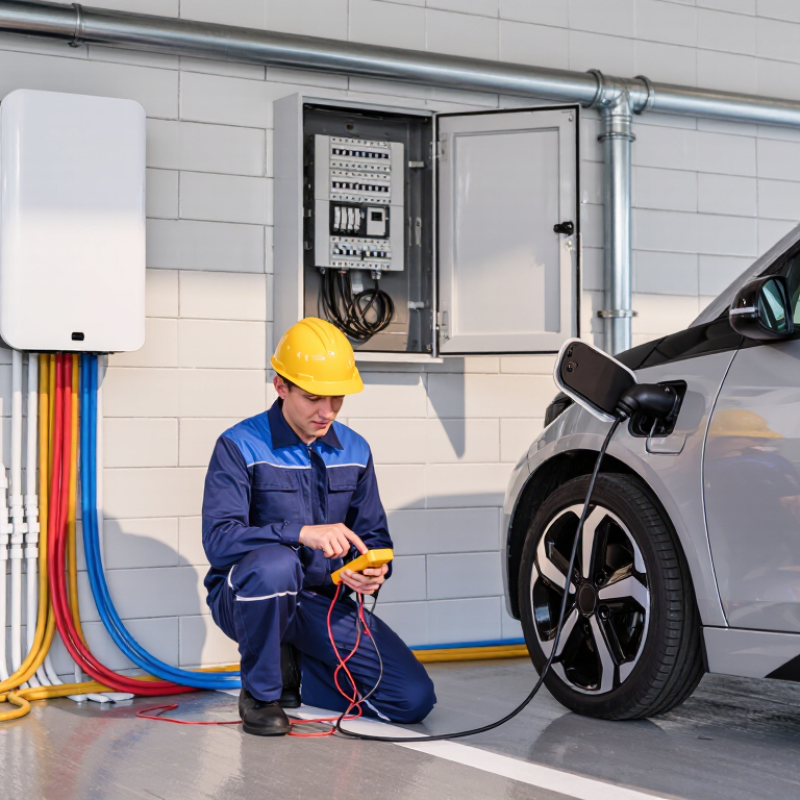
China Top EV Charger Installation Mistakes to Avoid

Understanding EV Charger Requirements in China

China Top EV Charger Installation Mistakes to Avoid

Understanding EV Charger Requirements in China

Installing an EV charger in China starts with the vehicle, not the wall. Charging interfaces, voltage, current, and communication requirements must match. Many residential sites use 220V single-phase power, while larger facilities may need 380V three-phase supply. Never assume the existing circuit is ready.

A qualified electrician should inspect cable size, breaker capacity, grounding, and available load. An overloaded distribution board can create heat, nuisance trips, or serious fire risks. Applicable requirements may include GB/T 18487.1 and the GB/T 20234 series. Local grid rules and property management policies also matter. They are easy to overlook. Protection should include suitable overcurrent and residual-current devices. Outdoor equipment needs proper weather protection, drainage, and safe clearance from water.

A practical lesson from site assessments is that drawings often miss real obstacles. Cable routes may cross fire doors, drainage channels, or shared parking spaces. Measure the route on site. Confirm who controls the parking bay and electricity meter. Public locations may need clear emergency access, usage records, and separate metering. The checklist is not perfect; local conditions still matter. Confirm the final design with the local power authority and a qualified installer before drilling.

Choosing the Correct Charger and Electrical Capacity

Choosing the Correct Charger and Electrical Capacity

Electric vehicle growth is making charger selection less forgiving. The International Energy Agency’s Global EV Outlook 2024 reported more than 14 million electric car sales in 2023 and over four million public charging points worldwide. Yet many home installations still begin with the charger, not the electrical supply. That order creates expensive surprises.

A site survey should check the main breaker, service rating, cable length, earthing, and available load. A 7.4 kW charger draws about 32 amps on a single-phase 230-volt circuit. An 11 kW unit usually requires three-phase power and suitable utility support. A 22 kW charger may look attractive, but many vehicles cannot accept its full output. Faster is not always better.

The U.S. Department of Energy’s Alternative Fuels Data Center identifies Level 2 charging as commonly operating near 7.2 kW. This is often practical for overnight charging, but local wiring rules and vehicle limits still control the decision. In many electrical codes, continuous loads require additional capacity, often calculated at 125 percent. Confirm the exact requirement with a qualified electrician.

The panel may disagree.

A useful check is simple: record the home’s peak demand while cooking, heating, and charging. If the numbers nearly fill the service, install load management or upgrade the supply before energizing the charger. I would not trust a neat wall installation that ignores a warm breaker, undersized cable, or a thirty-meter voltage drop. Those details are easy to miss, and they are where reliability starts failing.

China Top EV Charger Installation Mistakes to Avoid: Choosing the Correct Charger and Electrical Capacity

The chart compares common single-phase 240 V EV charger currents with the minimum circuit rating calculated at 125% of continuous charging load. Always confirm voltage, wiring, breaker capacity, grounding, and local electrical requirements with a qualified electrician before installation.

Avoiding Unsafe Installation Locations and Wiring

China EV Charger Installation Mistakes to Avoid

A safe EV charger installation begins with the location, not the charger. Avoid placing it where rainwater collects, even under a roof. Splashing water can reach sockets, cable glands, and wall openings. Keep the unit away from vehicle paths, tight corners, heat sources, and areas exposed to falling objects. Leave enough space for ventilation and routine inspection. In China, installers should follow applicable national standards and local inspection requirements. A qualified electrician should confirm the mounting surface can carry the equipment securely.

Wiring mistakes are more dangerous than untidy cable routing. The charger needs a dedicated circuit with suitable conductor size, protective devices, grounding, and overcurrent protection. Do not share its circuit with an oven, water heater, or other heavy load. Long cable runs may create voltage drop and heat. Use weather-resistant conduit outdoors, and protect cables from sharp edges, compression, and repeated bending. Every terminal should be tightened to the manufacturer’s specified torque. Loose connections can heat silently.

A useful admission: neat wiring does not prove safe wiring. Before energizing the circuit, an electrician should check insulation, polarity, grounding continuity, and protective-device operation. The distribution panel also needs enough capacity. An old panel may look acceptable but fail under continuous charging demand. Do not rely on guesswork. A second inspection can catch mistakes missed during a rushed installation.

Meeting Chinese Electrical Codes and Grid Connection Rules

Installing an EV charger in China is not simply a parking-space upgrade. The main risk is ignoring local electrical codes and grid-connection procedures. Before purchasing equipment, confirm the supply voltage, available capacity, and meter arrangement. Most homes use 220V single-phase power, while larger facilities may require 380V three-phase service. This difference changes cable sizing, protection, and approval requirements.

Use equipment and installation methods that match applicable GB/T requirements, including GB/T 18487.1 and relevant GB/T 20234 standards. A qualified electrician should verify grounding, conductor size, breaker selection, and residual-current protection on site. Do not copy a neighbor’s design. A long cable run through a shared garage can create voltage drop, heat, and inspection problems. Keep protective devices accessible, label circuits clearly, and protect outdoor connections from water ingress. Small details matter.

Grid connection is a separate step. Contact the local power supply service before construction. Application forms, load reviews, meter changes, and inspections vary by city and property type. Apartment owners may also need property-management consent and a cable-route plan. Commercial projects often require demand calculations, fire-safety coordination, and formal acceptance records. A passed test does not prove perfect installation; loose terminals can appear months later. Schedule torque checks and thermal inspections after commissioning.

China Top EV Charger Installation Mistakes to Avoid - Meeting Chinese Electrical Codes and Grid Connection Rules

No. Common Installation Mistake Relevant Chinese Electrical or Grid Requirement Practical Design Data or Checkpoint Recommended Verification Risk Level
1 Using a household socket without a dedicated circuit EV charging loads should be supplied by a properly designed dedicated circuit in accordance with applicable editions of GB/T 18487.1, GB 50054 and local utility requirements. A 7 kW single-phase charger draws approximately 32 A at 220 V. A 11 kW three-phase charger draws approximately 16 A per phase at 380 V. Check the feeder rating, protective-device coordination, cable temperature rating and continuous-load calculation. High
2 Ignoring the building's available capacity The connection must be compatible with the approved supply capacity and the requirements of the local distribution network operator. Calculate existing maximum demand plus charger demand, rather than comparing only the charger nameplate rating with the main breaker rating. Obtain the latest capacity information, single-line diagram and utility connection conditions before construction. High
3 Failing to balance single-phase charging loads Low-voltage distribution design should control phase imbalance and comply with the approved distribution design and utility requirements. Multiple 220 V chargers connected to the same phase can create neutral-current, voltage-drop and transformer-loading problems. Record the phase allocation on the single-line diagram and measure phase currents during simultaneous charging. Medium–High
4 Omitting residual-current protection EV charging installations require protection against AC and possible smooth DC residual currents in accordance with the applicable charging-system standard and equipment design. Use the residual-current protection method specified for the charger: an appropriate RCD arrangement or integrated DC residual-current detection where permitted. Confirm protection type, rated residual operating current, disconnection time and compatibility with the charger manufacturer's technical documentation. High
5 Leaving protective earthing unverified Protective conductors, equipotential bonding and earthing arrangements must comply with the applicable low-voltage installation and building electrical standards. Do not assume that a nearby metal pipe, parking barrier or structural steel member is an acceptable protective conductor. Verify PE continuity, conductor size, terminal tightness, loop impedance or earthing performance using calibrated test equipment. Do not apply a universal resistance value without checking the applicable design. High
6 Selecting cables only by normal current Cable selection must consider current-carrying capacity, installation method, ambient temperature, grouping, voltage drop and short-circuit protection under GB 50054 and project requirements. A 32 A charging circuit may require a larger conductor than a short indoor branch circuit when installed in conduit, underground, bundled or exposed to heat. Document conductor material, cross-sectional area, route length, correction factors and calculated voltage drop. High
7 Installing equipment with unsuitable environmental protection Outdoor and parking-area installations must satisfy the environmental, mechanical, water-ingress and fire-safety conditions specified by the project and applicable standards. Select the enclosure protection level, corrosion protection, impact resistance, operating temperature range and drainage arrangement according to the actual site. Check the site survey, enclosure rating, cable-gland sealing, canopy or drainage design and clearance from vehicle movement areas. Medium–High
8 Neglecting lightning and surge protection Lightning protection and surge protective measures should be coordinated with the building's lightning-protection system and the applicable requirements of GB 50057. Protection design should consider whether the charger is indoors, outdoors, on a rooftop, near exposed metalwork or connected through long external cable routes. Verify SPD type, installation location, backup overcurrent protection, lead length and connection to the equipotential bonding system. Medium–High
9 Skipping the utility connection and metering process Grid-connected charging facilities may require application, capacity review, metering, inspection and acceptance procedures defined by the local distribution operator. Public, commercial, residential and private charging projects can have different supply, metering and approval conditions. Confirm the point of connection, tariff or metering arrangement, approved capacity, required documents and energization procedure before ordering equipment. High
10 Using non-compliant charging connectors or control wiring Charging interfaces and conductive charging functions should comply with the applicable GB/T 20234 series and GB/T 18487.1 requirements for the intended charging mode. Check connector type, rated voltage, rated current, mechanical keying, communication/control functions and cable-temperature protection. Review conformity documents, wiring diagrams, connector test records and compatibility with the vehicle and charging mode. High
11 Ignoring fire-safety and parking-layout requirements Location, separation, evacuation access, fire compartmentation and cable penetration treatment must follow the applicable building, electrical and fire-safety requirements. Keep charging equipment out of vehicle-impact paths and maintain the clearances, access routes and maintenance space shown in the approved design. Obtain a site layout review covering fire access, emergency isolation, ventilation, cable routes, bollards and penetration fire-stopping. High
12 Putting the charger into service without testing Inspection and acceptance should follow the applicable charging-facility inspection standards, project specifications and local authority or utility procedures. Tests should cover PE continuity, insulation resistance, polarity, phase sequence where applicable, RCD operation, emergency stop, communication and functional charging. Create signed commissioning records with instrument identification, test results, protection settings, as-built drawings and maintenance instructions. High

Note: Chinese national standards, local building rules and distribution-operator requirements may be revised or applied differently by project type and location. Confirm the current approved editions and site-specific conditions before construction.

Testing, Maintenance, and Common Installation Errors

China Top EV Charger Installation Mistakes to Avoid

Testing, Maintenance, and Common Installation Errors

An EV charger can look correctly installed while hidden faults remain inside the enclosure. Many failures begin with undersized cables, loose terminals, or poor grounding. Before energizing the unit, a qualified electrician should check voltage, insulation resistance, earth continuity, and protective-device operation. Use calibrated test instruments, not visual judgment alone. Record every reading with the installation date and circuit details. Small readings matter.

A rushed installation may still charge successfully on day one, but that result proves little. Technicians should test the charger under load and observe connector temperature, current stability, and automatic shutdown functions. One common mistake is testing only the vehicle connection. The entire circuit needs attention. Check cable glands, weather seals, and wall fixings, especially for outdoor units exposed to rain and dust.

Maintenance should include terminal checks, cable inspection, cleaning, and software or fault-log review according to the equipment instructions. In coastal areas, inspect for corrosion more often. In dusty parking areas, clean ventilation openings carefully. Do not ignore intermittent faults. They often appear before serious damage. My practical concern is simple: inspection records are sometimes incomplete, making later diagnosis slower and less reliable. A clear maintenance log helps reveal patterns and supports safer decisions.

FAQS

What should be checked before installing an EV charger in China?

Start with the vehicle and electrical supply. Confirm the connector, voltage, current, communication, and charging requirements. Many homes use 220V single-phase power. Larger sites may need 380V three-phase power. Never assume the existing circuit is suitable.

Can an existing household circuit power an EV charger?

Sometimes, but inspection is necessary. An electrician should check cable size, breaker capacity, grounding, and available load. A shared circuit may overheat or trip repeatedly. Use a dedicated circuit. Guesswork is risky.

Where should an EV charger not be installed?

Avoid water-collecting areas, vehicle paths, tight corners, heat sources, and falling-object risks. Keep clear space around the unit for ventilation and inspection. Outdoor equipment needs weather protection and safe drainage. Under a roof is not always enough.

What wiring mistakes can create safety problems?

Do not share the charger circuit with an oven or water heater. Protect cables from sharp edges, crushing, and repeated bending. Long cable routes may cause voltage drop and heat. Tighten terminals to the specified torque. Loose connections can heat silently.

What protection devices are commonly needed?

The circuit usually needs overcurrent and residual-current protection. Grounding must be continuous and properly tested. Protective devices should remain accessible. Outdoor connections need protection against water entry. A neat panel can still be unsafe.

Which Chinese requirements may apply to EV charger installations?

Applicable requirements may include GB/T 18487.1 and the GB/T 20234 series. Local grid rules and inspection requirements also matter. Confirm the final design with a qualified electrician and the local power authority. Standards alone do not solve site problems.

What permissions may be needed for an apartment installation?

Confirm control of the parking space and electricity meter. Property-management approval may be required. A cable-route plan may also be requested. Shared garages need careful planning. Fire doors and drainage channels can block a route.

What should be inspected after commissioning?

Check insulation, polarity, grounding continuity, and protective-device operation. Review terminal tightness and cable temperature after regular charging begins. Consider a second inspection. A passed test is not perfection. Real conditions can expose missed mistakes.

Conclusion

Installing an EV charger in China requires more than selecting a convenient wall location. Homeowners and businesses should first confirm the vehicle’s charging requirements, available voltage, power capacity, and whether the local grid can support the intended load. Choosing a charger with unsuitable output or ignoring the building’s electrical capacity may cause overheating, repeated tripping, or slow and unreliable charging. What are common mistakes in EV charger installation? Typical errors include using undersized cables, poor grounding, weak protective devices, exposed wiring, and placing equipment where it is vulnerable to flooding, impact, excessive heat, or poor ventilation.

A safe installation should follow applicable Chinese electrical standards, property-management requirements, and grid-connection procedures. Professional assessment is especially important when installing chargers in shared parking areas or older buildings. After installation, the system should be tested for insulation, grounding, protection, communication, and stable charging performance. Regular inspections can identify loose connections, damaged cables, moisture, or abnormal temperature early. Clear documentation and scheduled maintenance help ensure safe, efficient, and dependable operation over time.

Ethan

Ethan

Ethan is a seasoned marketing professional with a deep expertise in our company's innovative product line. With a passion for sharing knowledge and insights, he takes the lead in regularly updating our corporate blog, where he explores industry trends, product features, and effective marketing......